
OUTBOUND EMAIL SYSTEMS
High-Volume Email Infrastructure
We design and operate SMTP relay, IP warming, and cold email infrastructure for organizations sending high volumes of outbound email. Our systems focus on inbox placement, reputation protection, and long-term deliverability across European and global mailbox providers.
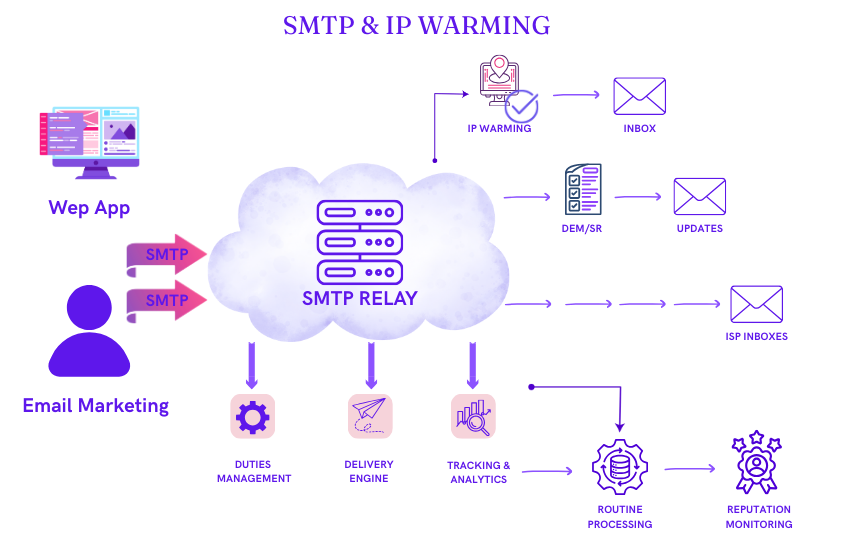
Email Infrastructure Built for Scale & Deliverability
We design, deploy, and operate dedicated email sending infrastructure for organizations that can't afford to share IP reputation with strangers. Every environment is engineered from the ground up for the specific sending requirements of each client.

Bulk Email Infrastructure
Complete outbound email infrastructure combining dedicated SMTP relay, per-ISP domain throttling, IP warming management, and bounce processing. Designed for organizations sending 100,000 to 50 million emails per month who need control over every layer of the delivery stack.
- ✓ Dedicated IPs — no shared reputation risk
- ✓ Per-ISP throttle configuration
- ✓ Automated bounce & complaint processing
- ✓ 24/7 DNSBL monitoring across 50+ lists

SMTP Relay Environments
Managed SMTP relay infrastructure that sits between your applications and recipient mail servers. Handles authentication (SPF, DKIM, DMARC), connection management, retry logic, ISP relationship management, and real-time queue monitoring — so your engineering team doesn't have to.
- ✓ Drop-in SMTP submission (port 587)
- ✓ Full authentication stack managed
- ✓ API injection for high-throughput apps
- ✓ Real-time queue depth monitoring

IP Reputation & Warming
Structured IP warm-up management with per-ISP ramp schedules, daily Postmaster Tools monitoring, complaint rate analysis, and real-time adjustments. We don't just warm IPs — we build lasting sender reputation at Gmail, Outlook, Yahoo, and every major mailbox provider from day one.
- ✓ Custom week-by-week ramp schedules
- ✓ Gmail Postmaster Tools monitoring
- ✓ Microsoft SNDS registration & tracking
- ✓ FBL registration with all major ISPs
Email delivery is not a tool.
It's infrastructure.
Most bulk email platforms focus on volume. We focus on control, reputation, and long-term inbox placement. The difference isn't visible on day one — it compounds over months and years.
When you send from a shared IP pool, your inbox placement rate is determined by the behavior of every other sender on that pool. A single bad actor — someone you've never met, sending to a list you'd never touch — can halve your open rates overnight. Dedicated infrastructure eliminates that variable entirely.
Infrastructure decisions are made before things break.
High-volume email systems rarely fail suddenly. They degrade under pressure, asymmetrically and quietly. Our work focuses on the conditions that precede failure — not the symptoms that appear after it.
SaaS & Platform Companies
Product-triggered email — onboarding sequences, in-app notifications, usage alerts — must reach the inbox within seconds. One shared IP blacklisting at Outlook affects your entire user activation funnel. Dedicated transactional infrastructure with stream isolation keeps critical product email separate from any marketing sends.
High-Volume B2C Marketers
E-commerce, financial services, and subscription businesses sending weekly campaigns to 500K+ subscribers can't afford the 15–25% inbox placement degradation that comes with shared ESP IP pools. Dedicated infrastructure with managed warm-up and per-ISP throttling consistently delivers 94–98% inbox placement rates.
B2B Sales Operations
Cold outreach at scale requires complete infrastructure isolation from all other sending. Shared IPs mean a spam complaint on your Monday campaign can kill Tuesday's deliverability for the entire organization. Our cold email infrastructure uses dedicated domains, isolated IP pools, and domain rotation designed specifically for B2B prospecting at volume.
What Separates Managed Email Infrastructure from Shared Platforms
The economics of email infrastructure are counterintuitive. A managed SMTP relay priced at €0.0009 per email looks dramatically cheaper than dedicated infrastructure — until you factor in that "delivery" at a shared ESP is not the same as "inbox delivery." An email that lands in Gmail's spam folder still counts as delivered. It costs you the same price per email. Your campaign statistics show 100% deliverability while your open rate sits at 8%.
Dedicated infrastructure changes the economics. When your IP reputation is isolated from every other sender in the world, your inbox placement is a direct function of your own sending behavior — your list quality, your complaint rate, your engagement signals. Good operators with clean lists consistently see 95–98% inbox placement. That 15–20% inbox placement improvement over shared infrastructure translates directly to campaign revenue at scale.
At 1 million emails per month with a €0.10 revenue-per-inbox-delivered email, the difference between 78% inbox placement (typical shared ESP) and 97% inbox placement (dedicated infrastructure) is €19,000 per month in additional revenue. The cost difference between the platforms is typically €300–€600 per month. The ROI calculus is rarely close.
Beyond inbox placement, dedicated infrastructure provides operational capabilities that shared platforms fundamentally can't offer: per-ISP domain-level throttle configuration, custom retry logic for specific bounce categories, real-time queue depth monitoring, stream isolation between sending types, and postmaster relationship access for fast resolution of ISP-level blocks.
These aren't premium features you unlock with a higher plan. They're structural properties of dedicated infrastructure that determine whether your email program is truly yours to control — or whether you're a passenger in someone else's reputation ecosystem.
The Infrastructure Stack We Build
Every client infrastructure deployment starts from the same architectural principles, then gets configured for the specific volume, use case, and ISP mix of the sending program:
- MTA selection and configuration: PowerMTA for operations above 1 million emails/day where its native per-domain throttling and structured accounting logs pay for the license; optimized Postfix for operations where the open-source toolchain is sufficient.
- IP allocation and authentication: Dedicated IPv4 IPs with valid PTR records, FCrDNS verification, SPF records for all sending domains, 2048-bit DKIM keys with documented rotation procedures, and DMARC at minimum p=none with active aggregate report monitoring.
- Stream architecture: Separate IP pools for transactional, bulk marketing, and cold outreach. Each pool operates in complete reputation isolation — a complaint spike in one stream cannot affect inbox placement in another.
- Monitoring stack: 24/7 DNSBL monitoring across Spamhaus ZEN, Barracuda BRBL, URIBL, and 47 additional lists. Gmail Postmaster Tools domain and IP reputation tracking. Microsoft SNDS integration. Yahoo FBL registration. Real-time queue depth alerting.
- Bounce and complaint processing: Automated hard bounce suppression, complaint-to-unsubscribe processing, and daily bounce rate analysis by ISP and list segment.
Volume Thresholds and When to Invest in Dedicated Infrastructure
The conventional wisdom is that dedicated infrastructure becomes economically justified at approximately 500,000 emails per month. That threshold is a reasonable starting point but misses a more important consideration: the nature of the email program, not just the volume.
A SaaS company sending 100,000 password reset and onboarding emails per month has more at stake per email than a newsletter publisher sending 2 million monthly marketing emails. If even 5% of password reset emails land in spam, users can't access their accounts — the deliverability failure has immediate, measurable product impact. For this use case, dedicated infrastructure is justified at volumes well below the conventional threshold.
Conversely, a marketing program with a highly engaged list, excellent content, and consistent sending practices may achieve acceptable inbox placement on shared infrastructure up to 1 million+ emails per month before the economics clearly favor dedicated. Volume and use case must be evaluated together.
Infrastructure Services
Free Tools
Quick Assessment
Describe your sending volume and use case — we'll tell you if dedicated infrastructure makes sense for your program.
Get Assessment →Frequently Asked Questions

Engineering Insights

- Engineering Memo · External Release
Retry Pressure: The Silent Killer of SMTP Reputation at Scale
VIEW ENGINEERING NOTE
- Engineering Memo · External Release
Why Inbox Placement Is a Lagging Indicator — And What to Monitor Instead
VIEW ENGINEERING NOTE
- Engineering Memo · External Release
Designing ISP-Specific Traffic Isolation for Cold and Bulk Email
VIEW ENGINEERING NOTE
- Engineering Memo · External Release
When Manual Intervention Beats Automation in Email Delivery Systems
VIEW ENGINEERING NOTE